Human Triggered Avalanche, Sliding Fall
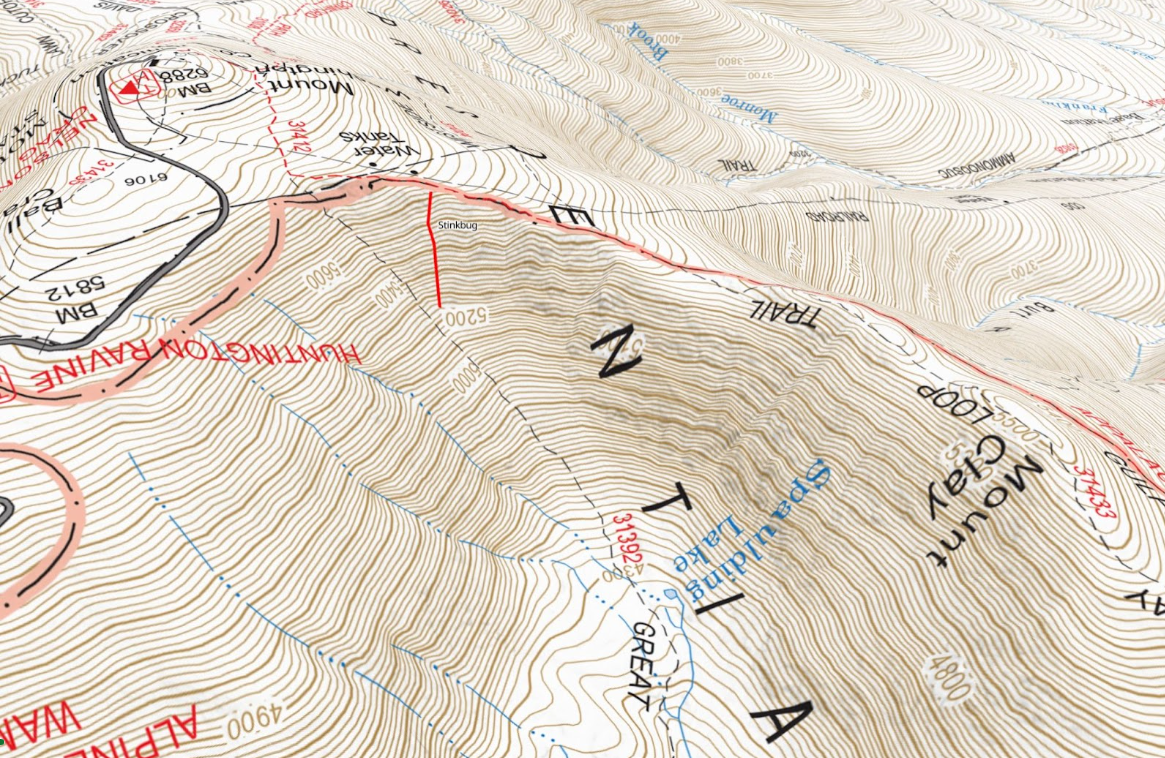
Location: Great Gulf, Stink Bug
Date: Saturday, January 31 2026
Overview
On Friday, January 31, 2026, two backcountry skiers (Skier 1 and Skier 2) ascended the Cog Railway with the intent of skiing Mother-in-Law in the Great Gulf. After determining that snow coverage at Mother-in-Law was less than expected, they changed objectives and entered Stinkbug Gully, a line they had not previously skied in terrain where they had no prior experience.
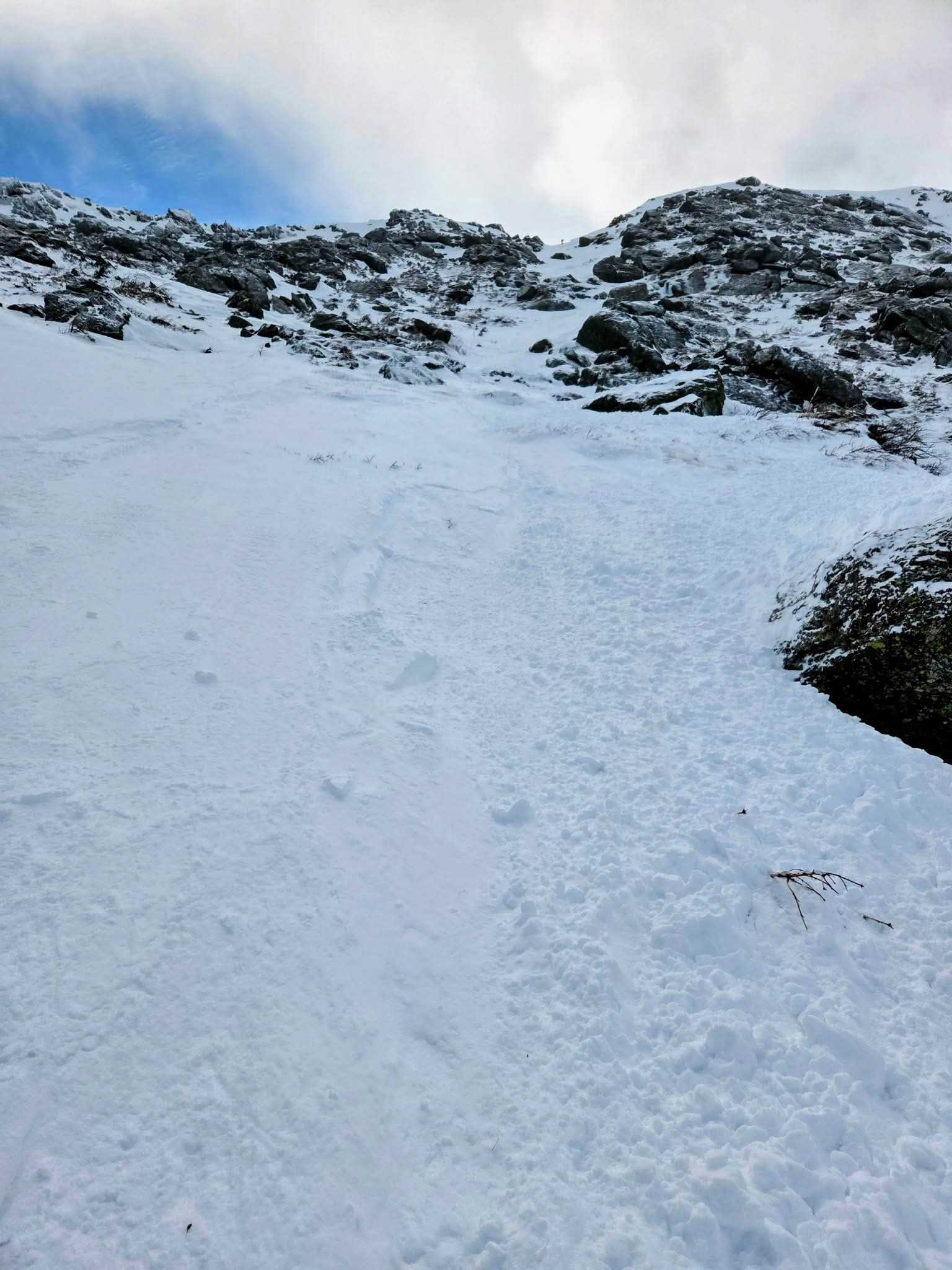
Shortly after entering the slope, Skier 1 triggered a hard slab avalanche and was caught and carried downslope through steep terrain and over a rock band, coming to rest on the surface of the debris (no burial). The avalanche crown was estimated at approximately 30 cm (1 ft) deep and spanned roughly the width of the narrow gully. Skier 1’s helmet was broken and equipment was damaged during the ride. Skier 1 lost skis and conducted a self-rescue, climbing back to Skier 2 using an ice axe on very firm snow. The party then descended the Cog Railway together and later sought medical evaluation; Skier 1 required stitches for a left knee laceration.
The event was reported to MWAC several days later by the involved party.
Weather/Snowpack:
The avalanche hazard rating for January 31 was MODERATE with a wind slab avalanche problem. Wind slabs were described as possible to trigger, with expected sizes ranging from D1 to D2, particularly in steep east-facing terrain above 3,000 feet.
The forecast “Bottom Line” stated:
You could trigger a large and destructive avalanche in east-facing terrain above 3000 ft. Warning signs will be limited, though hard slabs may sound hollow and drum-like underfoot. Look for pillowy smooth drifts on steep slopes to identify areas of potentially unstable snow and travel on wind-scoured surfaces to limit your exposure.
Wind slabs present at the time were primarily formed from approximately 18 inches of snow that fell on January 25–26 and was heavily redistributed by strong northwest winds on the 27th and 28th. This created thick drifts in lee terrain and a patchwork snow surface consisting of wind-scoured firm areas alongside wind-loaded slopes. Observations leading up to January 31 identified older wind slabs several days old that were becoming more stubborn but still remained possible to trigger. These slabs were reported to be resting over weaker snow, creating a strong-over-weak structure in places.
Weather conditions remained cold. The day prior, summit temperatures ranged from approximately -20°F in the morning to near 0°F in the afternoon, with northwest winds averaging over 40 mph and light snowfall recorded. On January 31, skies were partly sunny with temperatures moderating into the upper single digits above zero and northwest winds decreasing to 15–30 mph. Persistent cold temperatures helped preserve slab structure and limit bonding, maintaining the potential for human-triggered avalanches in wind-loaded terrain.
Events
Skier 1 and Skier 2 ski toured up the Cog Railway with the original intention of skiing Mother-in-Law in the Great Gulf. Upon reaching Mother-in-Law, they determined that snow coverage was less than expected and decided to change objectives. They selected a route called Stinkbug Gully, which appeared skiable from the top. Neither skier had previously skied this route, and they had no prior experience skiing in the Great Gulf.
From the top of Stinkbug, the slope appeared reasonable, and they were not aware of a rock band located lower in the gully.
While ascending the Cog, the party observed cornices along the side of the track, indicating recent or ongoing strong winds and potential wind loading in alpine terrain. This was noted by the party as a possible red flag for avalanche conditions.
Skier 1 entered the slope and began by making a ski cut with no results. Following this, Skier 1 made approximately two to three turns, and triggered a hard slab avalanche. This was described as a slab breaking into blocks of snow, indicating cohesive slab characteristics. Skier 1 attempted to ski out of the moving snow but was quickly knocked off his feet and carried downslope. The slope angle was steep, and Skier 1 described moving very fast within the avalanche.
The snow was very firm, and at times, the skier was either at the surface or just below the surface of the moving debris. When the avalanche reached the rock band, Skier 1 bounced over the rocks, experienced brief airtime, and then slid a short distance beyond the rocks before coming to a stop.
Skier 1 was not buried and came to rest on top of the snow.
Immediate Aftermath
Skier 1 was able to stand up. They noticed:
- The helmet was broken into two pieces
- One ski boot was cracked
- A Nalgene bottle had exploded in their pack
Skier 1 did not feel symptoms consistent with a head injury but noticed a small amount of blood and was initially more concerned about the blood visible on the snow than on their body.
Skier 1 attempted to contact Skier 2 via radio, but the radio batteries had been lost, and communication was not possible. Skier 2 moved to a vantage point, and they were able to visually confirm by waving that their partner was okay.
Self-Rescue and Exit
Skier 1 had lost skis in the avalanche, and decided to climb back up the gully the way they had come down. The snow surface was very firm, and they did not have crampons.
Using an ice axe, Skier 1 was able to climb back to the top of the slope. While climbing out, Skier 1 observed some ice near the rock band, but the majority of the slope consisted of firm snow.
The two skiers then descended the Cog Railway together. During the descent, Skier 1 noticed increased bleeding from their knee.
Medical Follow-Up
Skier 1 went to the hospital for evaluation and required stitches for a laceration on their left knee. No other injuries were reported.
Avalanche Statistics
Type: Hard Slab
Trigger: Skier, unintentional
Aspect: Northeast
Slope Angle: 38 degrees
Elevation: 5500 feet
Sliding Surface: New/Old Interface (from the description)
Vertical Fall: 600 feet
Discussion
This incident occurred during a period when the forecast avalanche problem was focused on hard wind slabs resting over weaker snow. In the days prior, storm snow from January 25–26 was extensively redistributed by strong west and northwest winds, producing a patchwork of thick slabs in lee terrain and cross-loaded snow onto adjacent slopes. Professional forecaster observations during this period described a snowpack that had generally stabilized and become stubborn to trigger, but with remaining structure concerns: cohesive slabs over weaker layers (strong-over-weak). In this kind of structure, the likelihood of triggering may be reduced by the bridging effect of a stiff slab, but the consequences can remain high if a skier finds a thin spot or a localized weakness that allows stress to reach the weak layer.
The avalanche involved a hard slab failure that released with limited preceding feedback, which is characteristic of many hard slab problems. Hard slabs can feel supportable and stable underfoot and may not produce common warning signs such as cracking or collapsing. When they do provide clues, they can be subtle, such as a hollow, drum-like feel, and those clues may not be present in the exact location where a slab is sensitive to trigger. As a result, skiers can enter steep terrain believing conditions are manageable, only to trigger a slab once a critical thin spot is crossed. In this case, Skier 1 performed a ski cut without results and then triggered the slab after a small number of turns, consistent with a scenario where sensitivity was spatially variable and the slab/weak-layer system provided minimal real-time warning.
This incident also highlights how terrain consequence can dominate outcomes even when the probability of triggering feels low. Stinkbug Gully is narrow, steep, confined terrain with a rock band below – features that compound consequences through increased trauma potential. In addition, the Great Gulf is a particularly difficult place to conduct a rescue. A serious injury in this drainage can require a long and complex evacuation in remote, steep terrain, with limited access, and exposure to hazards for rescuers. Even in the absence of burial, a sliding fall on firm snow can lead to traumatic injury that quickly shifts the situation from an avalanche event to a high-consequence medical and rescue problem, where time, conditions, and terrain become major constraints.
On days characterized by stubborn hard slabs, travel decisions on steep slopes are often less about detecting “reactivity” in the moment and more about weighing knowns, unknowns, and consequences. Known factors in this case included recent wind loading indicators (cornices observed during the approach), the presence of a forecast wind slab problem on lee aspects, and firm snow conditions that increase fall consequence. Unknowns included localized slab thickness, the continuity of the weak layer, and whether thin spots existed where a skier could more easily initiate failure. When consequences are severe, such as being swept through a terrain trap, over rocks, or into a location where rescue is difficult, small uncertainties can carry disproportionate risk.